
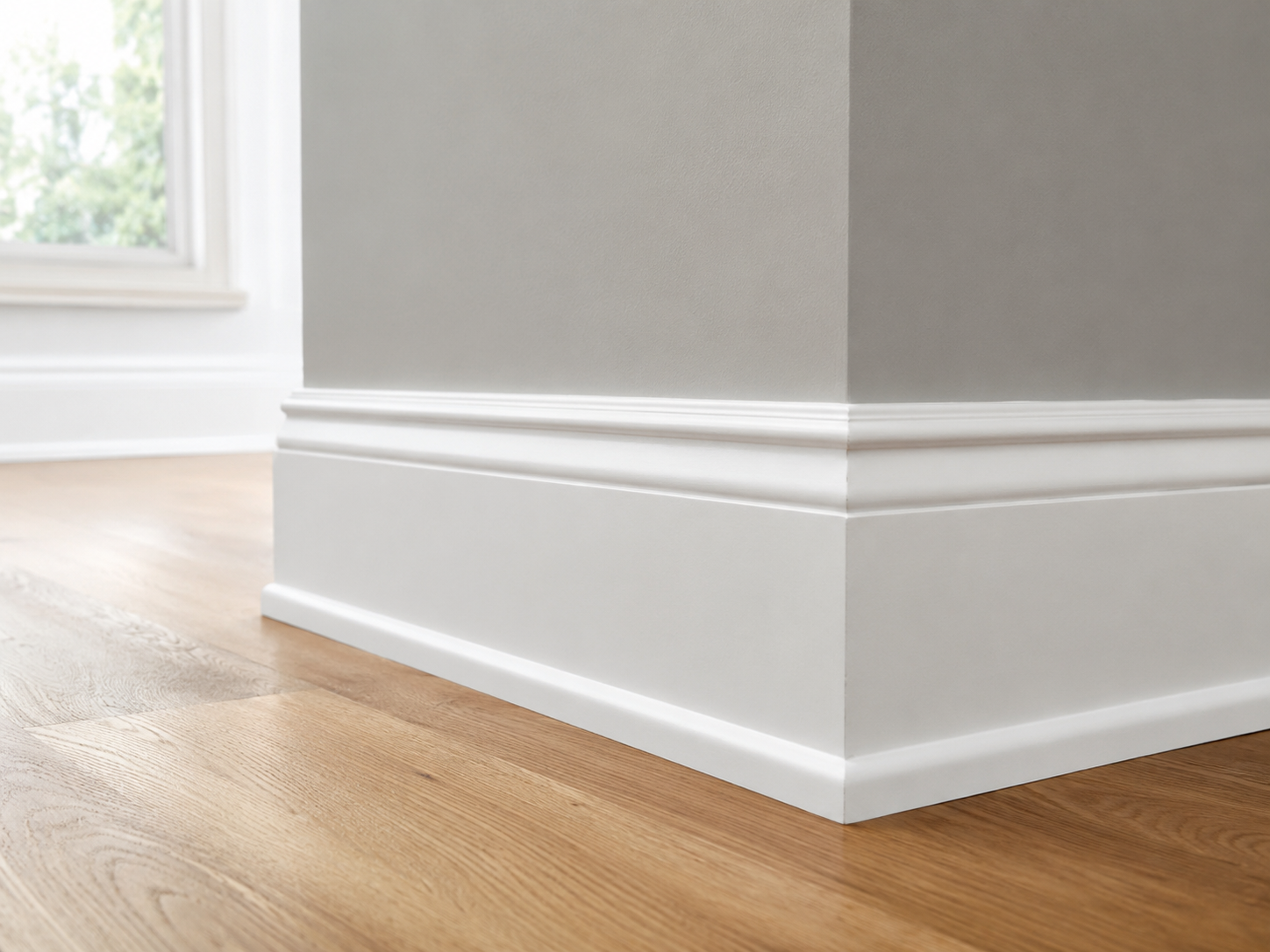
Walk into any room that’s been remodeled and most people couldn’t tell you exactly why it looks good or bad. But the feeling is immediate. Some rooms feel finished and intentional. Others feel like something’s off, even when the surfaces are all new.
More often than not, what you’re sensing is the trim work. Or the lack of it.
Finish carpentry is the layer of detail that ties a remodel together: the baseboards, the door casings, the window trim, the transitions between flooring and walls, the crown molding if there is any. When it’s done well you don’t notice it. When it’s done poorly, you can’t stop noticing it.
What trim work actually includes
When contractors talk about finish carpentry or trim work, they generally mean:
Each of these has to be measured, cut, fitted, nailed, and finished. The quality lives in the joints.
What separates good trim work from bad
Corners
Inside corners and outside corners are cut differently. Inside corners should be cope-cut, where one piece is shaped to overlap the profile of the other, rather than mitered. Cope cuts stay tight as the wood moves with humidity changes. Miter cuts at inside corners almost always open up over time, leaving a visible gap.
Poorly executed corners are the most common sign of rushed finish carpentry.
Reveals
A reveal is the small, intentional setback where one piece of trim steps back slightly from another. Door casings typically sit back a small amount from the edge of the door jamb. When this is consistent throughout the room, the eye reads it as clean and intentional. When it’s inconsistent, the whole casing looks sloppy even if every piece is technically straight.
Nail holes and caulk
Filled nail holes should disappear when painted. Caulk lines should be thin, consistent, and not stretched across large gaps. A wide caulk line is often a sign that the piece underneath wasn’t cut precisely and the caulk is covering the gap.
Transitions between materials
Where flooring meets a different flooring material, or where flooring meets a step or threshold, the transition strip needs to be level, tight, and correctly profiled for the materials on either side. A lifted, uneven, or incorrectly installed transition strip is a tripping hazard and an eyesore.
Why it matters more than people expect
Trim is installed last. It’s also finished last, usually after painting. That means it’s the final thing that gets done, often when a project is running long and everyone is ready to be done.
That’s exactly when it gets rushed, and rushed trim work is visible for the entire life of the renovation. A door casing with a 3mm gap at the miter joint doesn’t get better. It gets noticed every time someone walks through that doorway.
What to look for when hiring
Ask your contractor directly: who does the trim work? On some jobs, a general contractor will hire out the finish carpentry to a separate sub. That’s not necessarily a problem, but you want to know who it is and see examples of their work.
Look at corners in their past projects. Look at how door casings are installed. Look at whether the baseboards sit consistently tight to the floor or have gaps that were filled with caulk. Those details tell you everything about the level of care that went into the finish.
Summit Remodeling handles trim and finish carpentry in-house as part of every remodel project. It’s not an afterthought for us because we know it’s the layer that makes the whole project look like what was promised. If you’re planning a remodel in Summit County, Ohio and you want the details done right, give us a call.
continue reading